

Research
Mitochondrial Oxidative Stress, Cancer Metabolism, Mitochondrial Diseases, Maternal and Reproductive Health.
Background
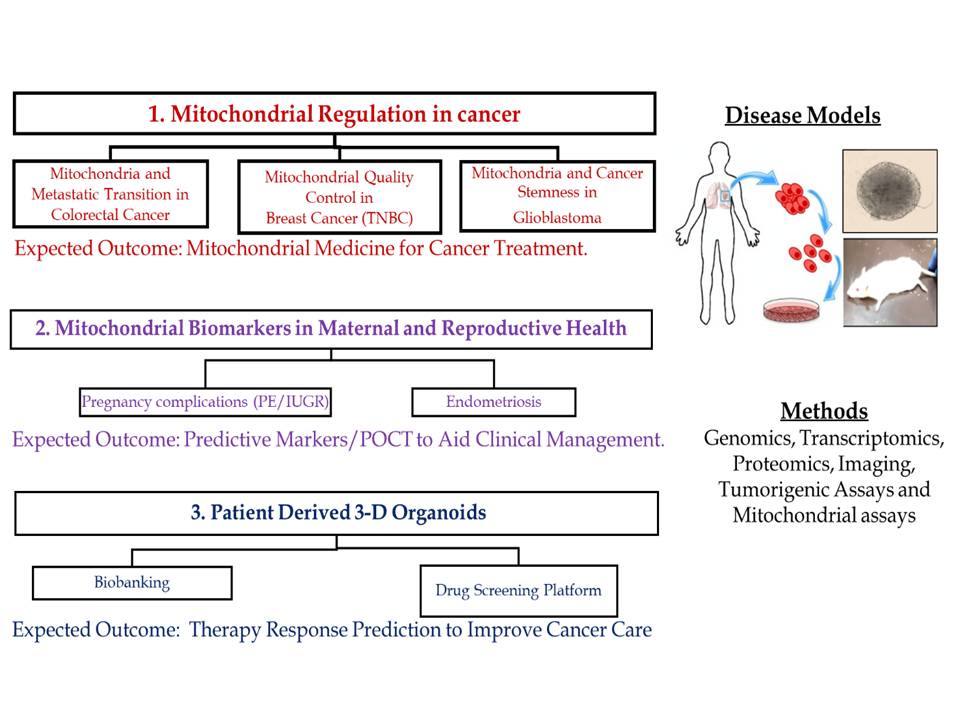
The laboratory's research program spans three interconnected areas of translational science: Mitochondrial biology in cancer, Mitochondrial biomarkers in maternal health, and patient-derived organoid platforms for drug screening. Collectively, the work is grounded in the understanding that mitochondrial alterations is a shared mechanistic driver across diverse disease states — from aggressive tumors to maternal health complications. With interdisciplinary collaborations of clinical departments within SGPGI, as well as external institutions, the laboratory investigates glioblastoma (GBM), colorectal cancer (CRC), and triple-negative breast cancer (TNBC) with respect to mitochondrial biogenesis, dynamics, mitophagy, and signaling, while simultaneously extending mitochondrial biology into reproductive medicine and precision oncology platforms. The following detail summarizes the research work exclusively carried out at SGPGIMS.
|
Research Area |
Clinical Problem Targeted |
Potential outcome in Clinical Care |
|
Mitochondria & Cancer |
Chemoresistance, tumor recurrence in GBM, CRC, TNBC |
Drug Repurposing, improving sensitivity to existing drugs; elimination of stem-like resistant cells |
|
Mitochondrial Biomarkers |
Lack of early diagnosis for PE, IUGR, endometriosis |
Point-of-care diagnostic tools for endometriosis; earlier intervention in high-risk pregnancies |
|
Organoid Drug Screening |
Absence of personalized therapy prediction platforms |
Patient-matched treatment selection; reduced trial-and-error in cancer care |
central role in cancer biology, contributing to tumor progression, metastasis, and resistance to chemotherapy. The laboratory investigates mitochondrial biogenesis, dynamics, mitophagy, and signaling across multiple cancers, including GBM, CRC and TNBC. The work reveals that glioblastoma-initiating cells (GICs) — the stem-like cells driving tumor recurrence — depend on mitochondrial reprogramming and quality control for their survival and chemoresistance. Disrupting mitochondrial fission and autophagic clearance eliminates these cells and sensitizes tumors to therapy, a mechanistic insight extended to metastasis in colorectal cancer and aggressiveness in TNBC, suggesting mitochondrial medicine as a new route for therapy and diagnostics.
Funding Support: SERB-DST, ICMR-EMR, SGPGIMS-IMG
Relevant Publications: Tiwari, M. et al. Cells (2024) 13, 447. Mathur S et al. BMC Cancer (2024) 24:323, Mishra A, et al. Am J Transl Res. (2024) Apr 15;16(4):1337-1352.Yadav P, et al. Gene. (2023) Jul 11:147636. Srivastava A, Curr Drug Targets. (2022);23(6):606-627. Rai NK, Biochem Biophys Rep. (2021) Feb 3;26:100931, Abbas S, et al., J Stem Cells Regen Med. (2020); 16(2): 80–89. Rai NK et al. Oncol Lett (2020) 20: 313.
- Biomarkers in Maternal and Reproductive Health
The laboratory is at the forefront of exploring mitochondrial damage-associated molecular patterns (mt-DAMPs) as early, noninvasive biomarkers detectable in biological fluids for pregnancy-related complications such as intrauterine growth restriction (IUGR) and preeclampsia (PE). Our findings demonstrate that mt-DAMP levels increase in response to physiological stress and rise progressively with advancing gestation in normal pregnancies. Ongoing studies aim to determine whether these markers can serve as early indicators of stress in complicated pregnancies.
We are also investigating whether similar alterations in mt-DAMPs are observed in other gynecological disorders, including endometriosis, which currently lack reliable early diagnostic tools. In parallel, through a recent collaboration and a 5Y MoU with Loyalist College, Canada, we have identified potential noninvasive dual biomarkers for endometriosis (independent of mt-DAMPs), which are presently undergoing validation in larger cohort studies.
Funding Support: SGPGIMS-IMG, DHR-GIA, ICMR-SRG
Publications: Srivastava, A., et al., BMC Pregnancy Childbirth. (2022) Nov 16;22(1):845, Srivastava A, Eur J Obstet Gynecol Reprod Biol. (2025);315:114778.
- Patient Derived Organoids as platforms for Precision Medicine
These three-dimensional organoids recapitulate the architecture and molecular features of original tumors and are characterized by integrating single cell RNA sequencing and drug response profiling. By optimizing these organoid cultures from patient cohorts, the laboratory is establishing living biobanks for predicting patient outcomes, testing treatment regimes, and enabling translational research that bridges molecular findings to real-time clinical care.
Funding Support: ICMR-SRG
Relevant Publications: Singh SK, Biotechniques. 2020 Nov;69(5):333-338.
Funding Support
Research Grants (Extramural)
- ICMR-Investigator Initiated Small Research Grant 2026-2029 (Role PI).
- ICMR-Investigator Initiated Research Grant 2024-2027 (Role PI).
- Department of Health Research-2023-2026 (Role-PI).
- Core Research Grant-SERB-DST- 2022-2025 (Ongoing) (Role: Co-PI).
- ICMR-Extramural Research Grant - 2019-2022 (Role: PI).
- Core Research Grant-SERB-DST- 2019-2022 (Role: PI).
- University Grants Commission (UGC)-Start up grant. 2015-2017 (Role: PI).
- DST Fast Track Young Scientist Grant SERB-DST: 2014-2017 (Role: PI).
Research Grants (Intramural)
- SGPGI Intramural Research Grant- 2023-2025 (Role: PI).
- SGPGI Intramural Research Grant- 2021-2023 (Role: PI).
- SGPGI Intramural Research Grant- 2019-2021 (Role: PI).
Mentor Grants:
- ICMR SRF fellowships (2):2022-2025
- ICMR-RA fellowship (1): 2022-25
Student Training:
PhD thesis supervision:
- Awarded (1), [Postdoctoral fellow at University of Utah, Salt Lake City, United States]
- Ongoing (6),
- Research Associate: Ongoing (2),
- Project JRF (3-completed, 1 ongoing)
- student’s thesis (Total=12),
- Volcker foundation student for summer training (1) at UTHSCSA.
- Full Bright International Visiting Scholar (1). (Dr. Abimbola Idowu, Lagos State University College of Medicine, Nigeria).
Thesis Examiner
- D. Thesis evaluation (Delhi University, NISER-Bhubaneswar, SRMU Lucknow, IIT-Jodhpur)
- Master’s Thesis Evaluation (AIIMS-Delhi)